
The Problem
Most retail and e-commerce teams still find inventory by hand. Store staff and operations teams search across ERPs, warehouse management systems, marketplaces, and supplier product data one system at a time, filtering by SKU, product line, or color. Because that search is manual and siloed, products get classified as out of stock before they need to be.
The searches themselves are often verbal descriptions of previous-season items — "that black running shoe with the white sole from last year" — which no keyword index handles well. When the lookup comes back empty, the downstream response is a backfill order or a make-to-order manufacturing request that was never necessary in the first place.
That process creates expensive errors.
The "not found" event is often a search failure rather than an actual inventory shortage. A product may be available, even if the correct keywords were not used to search for it. It may be located in a different warehouse, in receiving, or even in inventory as a different article that substantially meets the customer's requirements. If a retailer does not make these discoveries, they can end up over-buying, over-producing and over-shipping, all the while disappointing their customers.
There is measured evidence that the records themselves are part of the problem. A study of roughly 24,000 SKUs across 11 stores found inventory record inaccuracy rising with average inventory level, with restocking frequency, and with perishability — and a field experiment in which audits produced an 11% store-wide sales lift, concentrated specifically on items where the system record overstated what was physically there [1]. The authors' conclusion is worth carrying into any AI business case: stock counting reads better as "a sales-increasing strategy rather than a cost-intensive necessity."
Carrying more stock results in higher carrying costs, greater markdown risk, bigger spending on manufacturing than is optimal, and hidden operational friction across sales, fulfillment and procurement teams. The aggregate picture is a public statistic, not a vendor estimate: the Census Bureau publishes monthly retail inventories and inventories-to-sales ratios [4] inside the only monthly series covering total business activity across retail, wholesale and manufacturing [5].
The Solution
AI-powered inventory intelligence turns product lookup into decision-making. Instead of relying on an exact SKU or keyword match, the platform uses multimodal and semantic search to locate products already sitting in company inventory. It matches on four kinds of signal that manual search cannot reach:
- Product attributes (size, color, category, season, brand)
- Natural language descriptions from sales teams or customers
- Image-based similarity ("find items that look like this")
- Historical synonyms and naming variations across systems
The image axis is not decoration. Retrieval research on product search finds that a multimodal representation of an item improves either purchase recall or relevance accuracy over a text-only semantic retrieval model, with an explicit analysis of the matches only the multimodal model returns [2]. The text axis rests on the same grounding argument that motivated retrieval-augmented generation in the first place — parametric models are limited in their ability "to access and precisely manipulate knowledge," which is why answers are better drawn from an index than from the model's weights [3].
Using AI, the platform normalises product information from around diverse sources into one searchable index or repository. It then returns the confidence level for exact matches, comparable products, in transit products, and products in back order. Under the hood these are configurable retrieval decisions rather than a single toggle: chunking, semantic versus hybrid search, metadata filters over attributes such as season or warehouse, and reranking are each set independently in a managed retrieval layer [7]. The upshot for retailers is that they receive the information they need to decide whether to purchase, whether to go for an in transit product and incurr extra delivery costs, to seek alternative products that are closest in match, or to replenish faster.
- Fulfill from existing inventory
- Substitute with an approved equivalent
- Wait for inbound stock
- Trigger a targeted backfill or manufacturing order
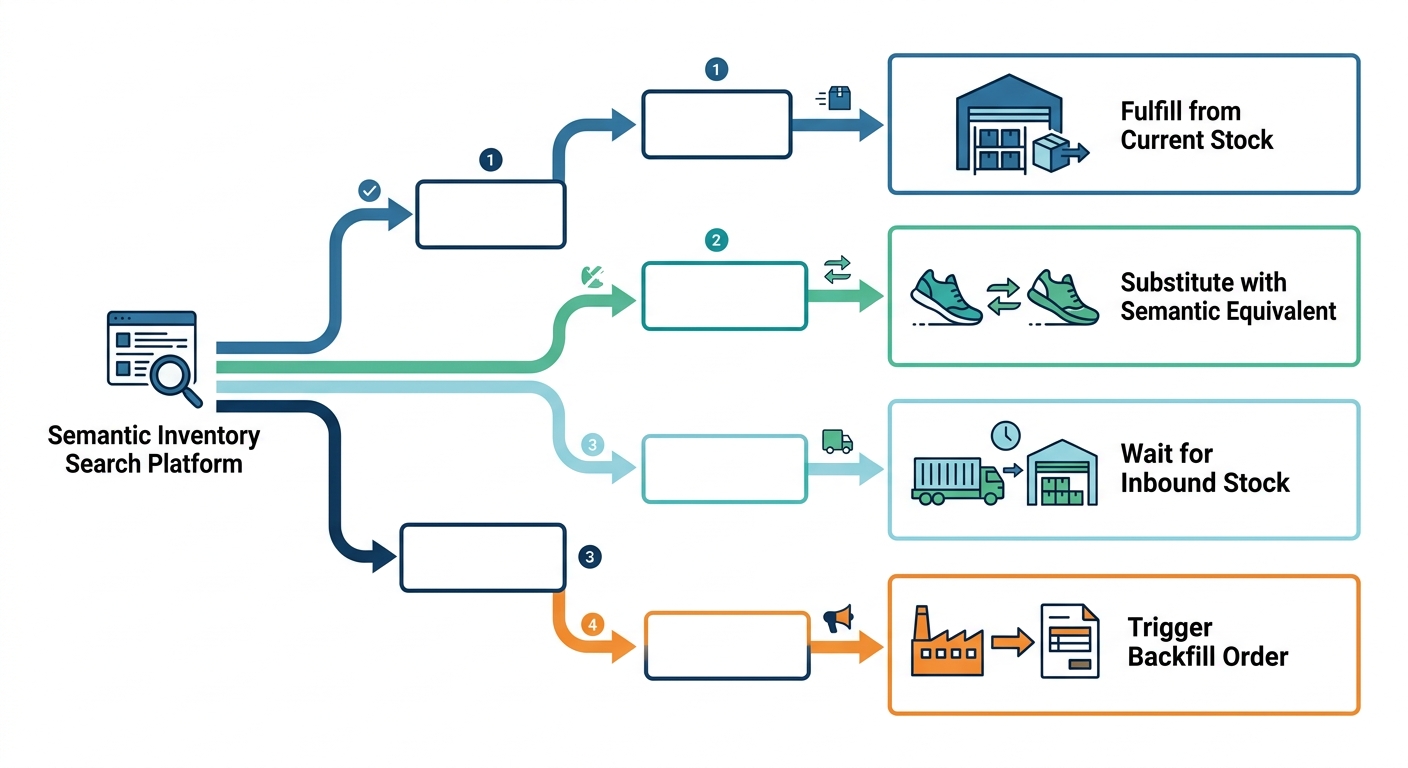
A decision flow diagram showing how semantic search results lead to specific operational outcomes: fulfilling from current stock, substituting with semantic equivalents, waiting for inbound stock, or triggering backfill orders.

This changes our approach from search and guess to search and verify.
ROI & Business Value
| Outcome | Impact |
|---|---|
| Lower operating cost | Reduces avoidable backfill and unnecessary manufacturing requests |
| Better inventory utilization | Finds existing stock before creating new supply |
| Faster order handling | Sales and support teams resolve customer requests in minutes, not hours |
| Reduced stockouts and overstock | Improves replenishment timing with better visibility into true availability |
| Fewer markdown losses | Prevents duplicate buying that leads to excess inventory |
| Cross-team efficiency | Aligns sales, warehouse, and procurement around the same real-time inventory signal |
Unlocking the biggest gain for Product teams: Better decisions. Stop treating uncertainty as a shortage.
How We Solved It with Jarvis AI
The solution combined a custom backend agent implementation with a business friendly Jarvis Chat frontend.
This is made possible by three coordinating layers: an agent gateway that secures and routes every inventory query, an agent registry that catalogs all approved data connectors across ERP, WMS, and supplier systems, and an agent orchestrator that sequences those agents to reconcile and rank results in real time. The split is now standard across the market — the hyperscaler equivalent reached general availability on 13 October 2025 with Runtime, Gateway, Identity, Memory and Observability as separate services, Gateway connecting to existing MCP servers [8], and ASCENDING's own registry documents tool-level access control with OAuth/SAML and complete audit trails for every AI interaction, with no security certification claimed [9]. For a detailed breakdown of how these components work together, see our guide on agent gateway, agent registry, and agent orchestrator architecture.
We have built an agentic flow in the backend, utilising Jarvis Registry in order to continuously crawl and reconcile information from a multitude of sources across the leviathan that is the backend's inventory systems – ERP, warehouse management systems, supplier catalogues, and marketplace feeds to name a few. This custom agent layer allows for the generation of a single master list of inventory across the backend, ensuring that everyone has a single source of truth when making decisions throughout the business, eliminating the need to constantly cross reference information across a multitude of independent systems.

We strove to keep the data as current as possible. By reducing the number of disconnected sources a client must query to compile up-to-date inventory information, we help to facilitate near real-time status reporting. For even the most complex configurations, this agent-based approach helps to dramatically reduce latency and increase consistency across systems, resulting in a lower number of false "not found" returns. Whatever platform you run it on, turn the telemetry on deliberately — model invocation logging on a mainstream inference platform ships disabled by default and only begins recording request and response data once a destination is configured [10].
Front-end users are able to query the inventory using Jarvis Chat without having to involve the technical team. The interface enables front-end users to search for products by size and description in natural language to retrieve actionable inventory answers.
Makes refill and backfill decisions much easier for your team. Accurately determines if existing inventory is available, whether there are alternative sources for the item, or if replenishment is even required. This builds real cost savings by reducing the number of purchase orders and manufacturing work orders for which your team is responsible.
Why This Matters for Future Retail Programs
Most retailers don't need more dashboards. What they really need is to make fewer expensive mistakes in their daily operations.
This use case demonstrates the value of applying AI to frontline decisions such as "Do we already have this item in stock?" and "Do we really need to Replenish Now?". By making accurate answers to these simple questions, significant reduction in operating cost and improved health of inventory can be achieved – all without increasing process complexity.
For teams looking to launch AI in Retail, one of the highest levers for ROI comes from inventory discovery and backfill accuracy — and the channel mix keeps raising the stakes, with US retail e-commerce sales reaching $326.7 billion in the first quarter of 2026, or 16.9% of total retail sales [6]. The architectural foundation — agent gateway, agent registry, and agent orchestrator — is what makes that accuracy possible at scale. Learn more in our deep dive on agent orchestrator workflows for retail operations.
FAQ
What is AI-powered inventory search?
AI-powered inventory search replaces exact SKU and keyword lookup with semantic and multimodal matching across every system that holds product data — ERP, warehouse management, marketplace feeds, and supplier catalogs. It matches on product attributes, natural-language descriptions, image similarity, and historical naming variations, then returns a confidence level for exact matches, comparable products, in-transit stock, and back-ordered items.
Why do retailers report items as out of stock when they aren't?
Because the "not found" event is usually a search failure rather than a real shortage. Product data sits in separate systems with inconsistent naming, so a search by SKU or keyword misses items that exist under a different article number, sit in receiving, or live in another warehouse. The miss then triggers a backfill order or a make-to-order manufacturing request that was never needed.
What does a false "not found" actually cost?
It compounds across three budgets at once: over-buying, over-producing, and over-shipping. Carrying more stock raises carrying costs and markdown risk, manufacturing spend runs above optimal, and the customer is still disappointed. The friction then spreads across sales, fulfillment, and procurement, because each team is working from a different view of what is actually available right now.
Which decisions does semantic inventory search change?
Four, and they are the ones that move cost. Once search returns ranked matches with a confidence level, the team can fulfill from existing inventory, substitute an approved equivalent, wait for inbound stock, or trigger a targeted backfill or manufacturing order. The shift is from search-and-guess to search-and-verify, so uncertainty stops being treated as a shortage by default.
Do we have to migrate our ERP and warehouse data first?
No. The platform normalizes product information from the existing sources into a single searchable index rather than replacing any system of record. An agent layer continuously crawls and reconciles ERP, warehouse management, supplier catalog, and marketplace data into one master inventory list, so the source systems stay exactly where they are and the reconciliation happens above them.
How current is the inventory data?
The design goal is near-real-time status, reached by cutting the number of disconnected sources a team must query before it can state availability. An agent-based reconciliation layer reduces latency and increases consistency across systems even in complex configurations, and that consistency is what drives down the rate of false "not found" results at the point of decision.
References
- A study of roughly 24,000 SKUs across 11 grocery stores finds inventory record inaccuracy rising with higher average inventory levels, more frequent restocking and product perishability, and reports a field experiment in which audits produced an "11% store-wide sales lift" concentrated on items whose system records overstated actual stock — the authors reframe stock counting "as a sales-increasing strategy rather than a cost-intensive necessity" — Rekik, Oliva, Glock and Syntetos (2026): https://arxiv.org/abs/2506.05357
- Research on multimodal semantic retrieval for product search finds that "a multimodal representation scheme for a product can show improvement either on purchase recall or relevance accuracy in semantic retrieval," and analyses the exclusive matches a multimodal model returns that a text-only model does not — Liu and Lopez Ramos (2025): https://arxiv.org/abs/2501.07365
- The paper that introduced retrieval-augmented generation notes that pre-trained models' "ability to access and precisely manipulate knowledge is still limited," and that provenance and knowledge updates remain open problems — the argument for answering from an index rather than from model weights — Lewis, Perez, Piktus et al., NeurIPS (2020): https://arxiv.org/abs/2005.11401
- The Census Bureau publishes monthly retail inventories and inventories-to-sales ratios as part of the Monthly Retail Trade Survey, with June 2026 data released 14 August 2026 — US Census Bureau (2026): https://www.census.gov/retail/mrtsinv/inventories.html
- The Manufacturing and Trade Inventories and Sales report provides "broad and timely measures of combined changes in domestic retail trade, wholesale trade and manufacturers' activities" and is "the only source of monthly data on total business activities of retail trade, wholesale trade, and manufacturers" — US Census Bureau (2026): https://www.census.gov/mtis/index.html
- US retail e-commerce sales for the first quarter of 2026, adjusted for seasonal variation, were $326.7 billion, accounting for 16.9 percent of total retail sales, released 18 May 2026 — US Census Bureau (2026): https://www.census.gov/retail/ecommerce.html
- A managed retrieval layer exposes the number of source chunks returned, search type (default, hybrid or semantic), manual and implicit metadata filtering with equals/notEquals/greaterThan/in/notIn operators combinable through andAll and orAll groups, reranking and query decomposition as independent settings — the knobs behind a "confidence level" on a product match — Amazon Web Services (2026): https://docs.aws.amazon.com/bedrock/latest/userguide/kb-test-config.html
- Amazon Bedrock AgentCore reached general availability on 13 October 2025 with Runtime, Memory, Gateway, Identity and Observability as separate services, Gateway connecting to existing MCP servers and turning APIs and Lambda functions into agent-compatible tools — Amazon Web Services (2025): https://aws.amazon.com/about-aws/whats-new/2025/10/amazon-bedrock-agentcore-available/
- ASCENDING's Jarvis Registry page documents "Fine-grained access controls at the tool level with OAuth/SAML integration," "complete audit trails for every AI interaction," AWS Marketplace availability and Kubernetes deployment across EKS, AKS and GKE, with no security certification claimed — ASCENDING (2026): https://ascendingdc.com/jarvis-ai/jarvis-registry/
- Amazon Bedrock model invocation logging "is disabled by default"; once a CloudWatch Logs or Amazon S3 destination is configured it records the full request and response plus the caller's IAM/STS ARN, model ID, operation and token counts — Amazon Web Services (2026): https://docs.aws.amazon.com/bedrock/latest/userguide/model-invocation-logging.html